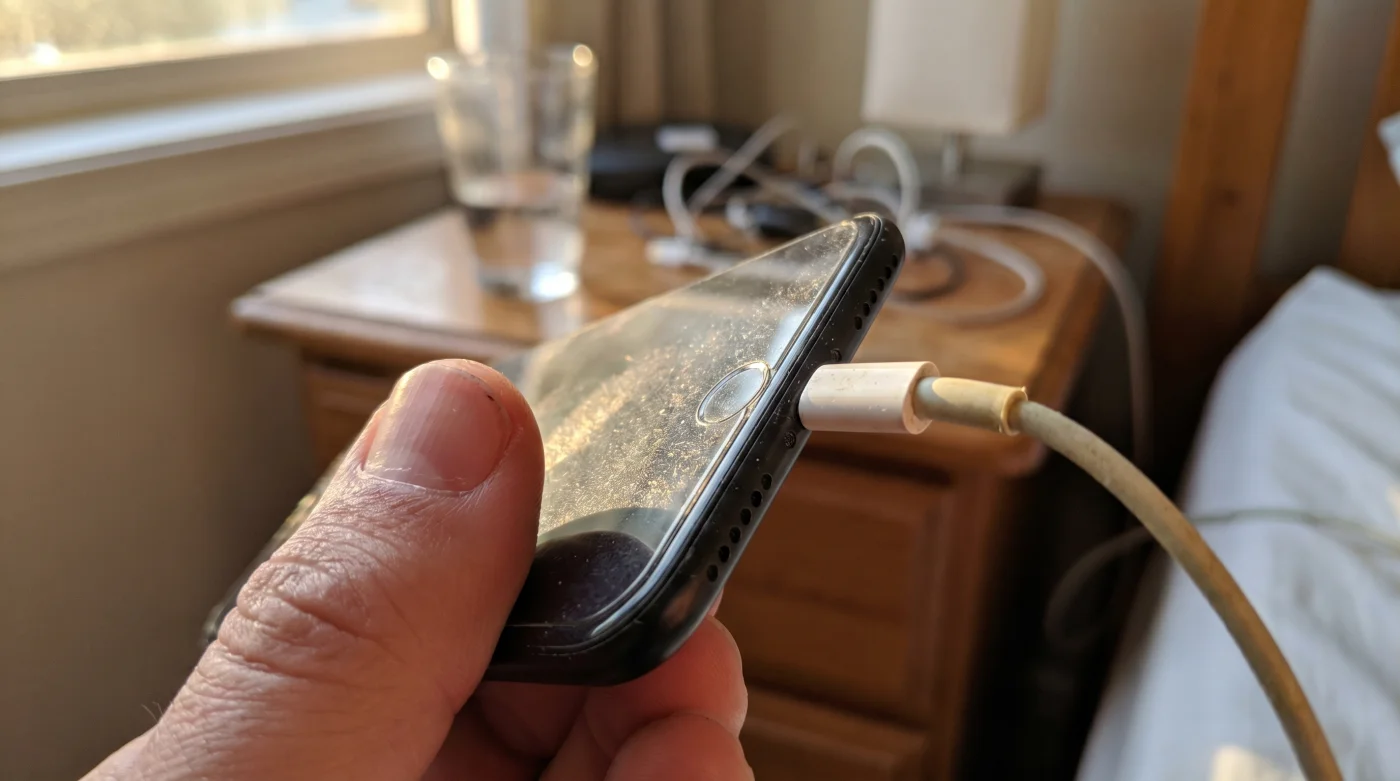
The house settles into the quiet rhythm of a Tuesday night. Rain taps against the windowpane, the bedside lamp clicks off, and there is that familiar, comforting ritual: reaching for the charging cable. You hear the soft chime of the connection, trusting the device will quietly replenish itself while you sleep.
Waking up to solid green has always felt like the responsible thing to do. It feels like starting the day with a full tank, a psychological safety net against the unpredictable demands of modern life.
Yet, beneath the sleek glass and precisely machined aluminium casing, a miniature chemical storm is brewing. We have been conditioned to believe that absolute fullness is the ultimate goal, but treating a delicate lithium-ion cell like an empty bucket is silently breaking it down.
The truth is far less intuitive than the industry standard implies. Storing your device at its maximum capacity for eight hours every single night is not preparing it for the day; it is suffocating it.
The Illusion of One Hundred Percent
Think of a lithium-ion battery not as a rigid container, but as a lung taking in air. Drawing breath feels natural, but holding your lungs completely full, straining against the pressure for hours on end, is exhausting.
Holding a cell at maximum voltage forces the chemical components to remain in a highly stressed, stretched state. The longer it sits at that absolute limit, the harder the internal structure works to maintain stability. The ions are essentially jammed against the walls of the cell, desperately trying to return to a neutral state.
Industry engineers have known for years that this prolonged tension accelerates cellular degradation by a staggering 40 percent. It fundamentally contradicts the belief that a full charge is optimal. The metals inside corrode faster, and the capacity to hold energy shrinks imperceptibly night after night.
You are essentially wearing out the engine while the car is parked in the driveway. The pursuit of that perfect, round number on your screen is actively cannibalising the lifespan of the hardware.
Consider Simon, a 42-year-old former Apple technician operating a quiet repair shop just outside Manchester. Over a decade of sliding open devices to reveal exhausted, faintly swollen battery packs taught him a counterintuitive lesson. “The people who treated their phones with the most care—religiously plugging them in at ten o’clock and unplugging them at seven—were the ones queuing up for replacements in under eighteen months,” he recalls. Amidst the smell of soldering flux and the hum of diagnostic tools, Simon realised that the most diligent users were inadvertently smothering the chemistry inside.
- The diamond-cut alloy wheel feature secretly costing UK drivers thousands in repairs
- Women over 50 are ditching hyaluronic acid in winter-here is the clinical reason why
- The single sheet of parchment paper error ruining your air fryer chips
- The prohibited boiler setting plumbers use to slash winter heating bills by 300 pounds
- Mechanics reveal the 10-second WD-40 trick that restores clouded headlamps instantly
Adjustment Layers for Daily Rhythms
Not everyone interacts with their digital tools in the same way. The solution requires a slight adjustment to how you view your daily routine, depending on the demands of your schedule.
For the Desk Bound Worker: If you spend your days at a desk, occasionally resting your device on a wireless charging pad, plugging it in overnight is entirely redundant. Your battery is constantly sipping power throughout the day. By the time you retreat to bed, the device is likely carrying enough energy to survive the night and comfortably reach your office desk the next morning.
For the Erratic Sleeper: Modern operating systems attempt to learn your sleeping habits to delay that final, stressful push to full capacity until just before you wake. However, if your shifts change or your sleep is fractured, the software fails.
The algorithm simply panics and pushes the charge to the top immediately, leaving it there to degrade. You cannot rely on an automated guess if your routine fluctuates; manual intervention is far kinder to the device.
Mindful Application and the Tactical Toolkit
Shifting away from the nightly ritual requires a gentle restructuring of your habits. You are moving from passive negligence to active, mindful management.
The goal is a comfortable equilibrium, keeping the chemistry relaxed rather than strained. This means aiming to keep the energy levels hovering in the middle ground.
- Check your battery settings and activate the strict 80 percent charging limit if your software allows it; this acts as a hard stop against voltage stress.
- Adopt the grazing method: plug in for twenty minutes while boiling the kettle or taking a shower, rather than a single marathon session.
- Never leave the device baking on a fabric surface like a duvet; heat compounds the chemical strain of a high charge exponentially.
- If you must charge overnight, position the device on a cool, hard surface like a wooden bedside table to allow the aluminium chassis to dissipate warmth naturally.
The Tactical Toolkit requires noting a few specific parameters to truly master this habit. Aim for a target range of 20 to 80 percent capacity, keep ambient exposure below 35 degrees Celsius, and use slower, 5-watt chargers if a device must be plugged in for extended periods.
Releasing the need for perfection is surprisingly liberating. It removes a tiny, subconscious layer of anxiety from your evening routine.
The Bigger Picture
Your device is a functional tool, not something that requires feeding until it bursts. By allowing it to rest at a comfortable, natural level of charge, you are respecting the physics that power your day.
You stop fighting the inevitable decay and instead, you gently extend the useful life of the object in your hands. It is a small, quiet rebellion against the assumed standard, yielding years of reliable performance.
The healthiest battery is one that breathes; never starved, never stuffed, simply floating comfortably in the middle.
| Key Point | Detail | Added Value for the Reader |
|---|---|---|
| Maximum Voltage Stress | Holding charge at 100% stretches chemical components. | Prevents premature swelling and severe capacity drops. |
| The 80% Limit | Restricting top-end charging lowers internal heat and pressure. | Extends total hardware lifespan by up to 40 percent. |
| Grazing Method | Topping up in 20-minute bursts instead of 8-hour blocks. | Aligns with daily breaks, removing evening charge anxiety and protecting the cell. |
Frequently Asked Questions
Does leaving my phone plugged in overcharge it? No, modern circuits prevent literal overcharging, but they do hold the cell at maximum voltage, which causes chemical fatigue.
Is it better to let the battery drain to zero? Absolutely not. Deep discharges cause just as much chemical stress as maximum charges. Aim to keep it above 20 percent.
Why does my phone get hot when charging in bed? Fabrics trap the heat generated by the battery. Combined with high voltage, this accelerates degradation immensely.
Should I use a weaker plug adapter at night? Yes. A slower 5-watt charger produces far less heat than a modern fast charger, which is gentler on the chemistry during long periods.
Will this actually save me money? Yes. Delaying a battery replacement keeps roughly 89 Pounds Sterling in your pocket and maintains the resale value of your device.